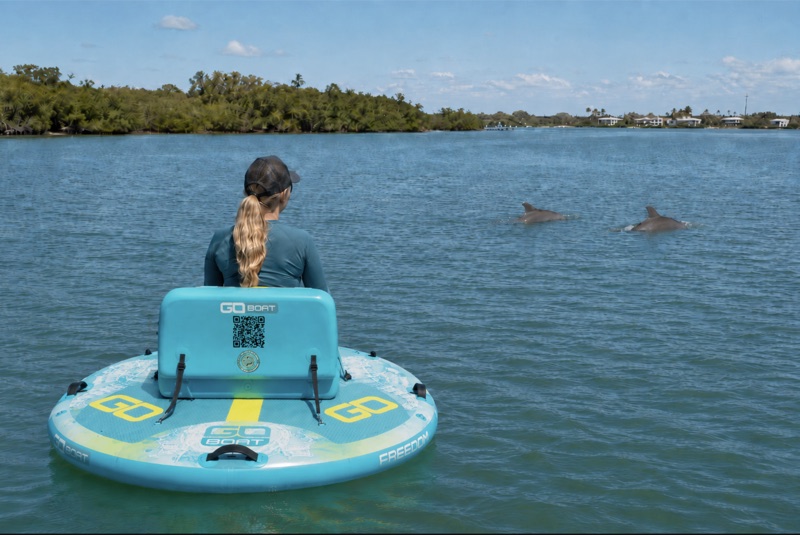
If you've been searching for dolphin watching in Palm Coast, or wondering where to see dolphins in Flagler Beach, here's the local answer: you don't need a big vessel or a crowded deck. Bottlenose dolphins live in the Intracoastal Waterway year-round, and some of the best seats in the house are on a quiet little electric boat you drive yourself. We're Salt & Springs Outfitters, and we run a fleet of self-guided GoBoat rentals on this exact stretch of water. This is our honest guide to where dolphins tend to show up, when the odds are best, and how to watch them the right way.
Why This Stretch of Water Is Dolphin Country
The Intracoastal Waterway and the Matanzas between Palm Coast and Ormond Beach are protected, food-rich estuary — exactly the kind of habitat bottlenose dolphins favor. Tides push bait fish through channels and past oyster bars and marsh edges twice a day, and the dolphins follow the groceries. Unlike migratory whale species that pass Florida seasonally, our bottlenose dolphins are residents. They're here in January and they're here in July, working the same creeks and channel edges their whole lives.
That's the good news. The honest news is that "resident" doesn't mean "on schedule." Dolphins range widely, and no launch, hour, or tide guarantees a sighting. Anyone who promises otherwise is selling you something. What we can tell you is where they're seen regularly, and how to stack the odds in your favor.
Why a Boat You Drive Yourself Changes the Experience
Most people's dolphin encounters happen from a dock or a big, loud vessel on somebody else's timetable. A self-guided electric GoBoat flips that:
- You set the pace. If a pod is working a bait school off a marsh point, you can put the motor in neutral and simply stay — ten minutes or an hour. Nobody's herding you back to a dock.
- The motor is nearly silent. The whisper-quiet electric drive doesn't announce you from half a mile away, so wildlife tends to carry on doing what it was doing instead of scattering.
- You sit low and close to the water. When a dorsal fin rolls thirty yards off, you're at eye level with it — not looking down from a deck rail.
- No license, no experience needed. The boat tops out at 5 mph, and you'll be comfortable with the controls in minutes.
Launches That Put You on Dolphin-Frequented Water
We deliver and set up at approved launches from Palm Coast down to Ormond Beach. These are the ones where dolphins and manatees are a regular part of the scenery — see the full list on our launch locations page.
Bing's Landing — Palm Coast
A hammock hideaway under shade oaks with a quick-launch ramp, restrooms, and Captain's BBQ on site. Dolphins and manatees are regularly spotted moving past this stretch of the Intracoastal, which makes it our most popular pick for wildlife-minded renters who also like the idea of barbecue afterward.
High Bridge Park — Ormond Beach
Shaded, kid-friendly riverfront about 12 minutes south of Flagler Beach, with picnic tables, restrooms, and a classic bait shop at the drawbridge. Manatees, dolphins, and the occasional gator all turn up in this reach of the river — a great family launch.
Rivershore/Oceanshore Fishing Dock — Ormond Beach
A quiet, locals-only river dock 11 miles south, near the wild marsh maze around the Tomoka basin. It's known for bull redfish, snook, and drum — and for the manatees and dolphins that work the same water. No facilities, all wildlife.
Roberta Fishing Dock — Ormond Beach
A hidden Halifax River plank the locals love, with fast access to the marsh maze and boat-only islands. Snook, redfish, ospreys overhead — and dolphins sharing the channel.
Honest Tips for Better Odds
No tricks here, just pattern-reading that holds up over a lot of mornings on this water:
- Go early and go calm. Flat, glassy water makes a rolling fin visible from hundreds of yards. Calm mornings are generally your most productive window — and the light is better, too.
- Fish the tide, so to speak. Moving water moves bait, and dolphins hunt where the bait is. A flooding or falling tide tends to beat dead slack.
- Watch channel edges and drop-offs. Dolphins often patrol the seam where deeper channel meets shallow flat. Slow down along those edges and scan.
- Follow the commotion. Diving pelicans, wheeling terns, and nervous, showering bait fish all point to feeding activity — and dolphins frequently show up to the same buffet.
- Look for the exhale. You'll often hear the soft "pfff" of a dolphin surfacing before you spot it. Quiet boat, quiet crew, better odds.
- Bring polarized sunglasses. They cut the glare and make everything under and on the surface easier to read.
And the part we'll always say out loud: sightings are never guaranteed. These are wild animals on their own agenda, not an attraction on a track. Honestly, that's what makes the moment a fin breaks the surface next to your boat feel like something you earned.
Watching Responsibly: The Rules That Protect the Show
Dolphins and manatees are protected by federal law — the Marine Mammal Protection Act — and the rules exist so that wild animals stay wild. This is the part of the orientation we care about most:
- Never feed, chase, or harass dolphins. Feeding teaches them to approach boats, which gets dolphins injured and killed. It's also illegal, full stop.
- Keep your distance. Stay at least 50 yards away when possible. Don't steer toward a pod, cut across its path, or box animals in against a shoreline.
- Neutral is your friend. If dolphins are near, put the motor in neutral and drift. Curious dolphins sometimes choose to come closer — that's their call to make, never yours.
- Manatees: look, never touch. No petting, no offering water or food, no following. If you see a swirl or a snout, enjoy it from a respectful distance and let them move on.
- Never swim toward or enter the water near marine mammals. Admire from the boat.
The quiet, slow, 5-mph nature of a GoBoat makes all of this easy — you're already the least disruptive thing on the water. Keep it that way and the wildlife keeps showing up, for you and for everyone after you.
How to Do It: Your Boat, Your Morning
Our self-guided GoBoat rentals start at $129 for 4 hours or $199 for a full 8-hour day. You drive, no boating license needed, and we handle everything else: we deliver the boat to an approved launch, set it up, walk you through a short orientation, and pick it all up when you're done. If wildlife is the whole point of your day, add our self-guided dolphin-watching package to any rental — it's built exactly for this kind of slow, scan-the-water morning.
The Bottom Line
Palm Coast and Flagler Beach sit on some of the most reliable dolphin water in Florida — a protected estuary where bottlenose dolphins live year-round. Launch from Bing's Landing, High Bridge Park, or one of the quiet Ormond Beach docks, go early on a calm morning with a moving tide, keep the motor quiet and your distance respectful, and let the river do the rest. Questions about launches or the dolphin-watching add-on? Call us at (386) 585-2698 or check the FAQ.
← Back to The Captain's Log